Follow along with the video below to see how to install our site as a web app on your home screen.
Note: This feature may not be available in some browsers.
Our discussion boards are an opportunity to discuss our Atomic Articles or start your own posts on topics that inspire you in the General Discussion Board. You can ask questions and get AI & academic answers in our Question Room. If you're feeling knowledgeable you can answer a question.
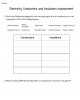
In this lesson, students will differentiate between conductors and insulators and understand how they affect electrical circuits. The teacher will review conductors, insulators, open circuits, and closed circuits before presenting the effect conductors and insulators have on electrical circuits. Students will complete a "Circuit Challenge" activity where they choose the best conductor to close a circuit. The students will then choose between three options to create and label a complete circuit before completing the assessment. The extensions include a conductors and insulators scavenger hunt, a circuit building lab, or a read and response activity.
This lesson is scaffolded learning to independent practice. Digital components are provided for easy delivery for online classes.
Learning Objective
Students will be able to:
Describe conductors and insulators and their role in electrical circuits
Identify, label, and build complete circuits
Success Criteria
Differentiate between conductors and insulators.
Demonstrate that electricity travels in a closed path, creating an electric circuit.
UK Curriculum Links
Year 4 Programme of Study: Electricity
Students will construct a simple series electrical circuit.
Students will identify whether or not a lamp will light in a simple series circuit.
Students will recognise some common conductors and insulators, and associate metals with being good conductors
US Curriculum Links / NGSS
Grade 4
Students who demonstrate understanding can:
4-PS3-4. Apply scientific ideas to design, test, and refine a device that converts energy from one form to another.
Key Vocabulary
Conductor: A material that allows heat or an electric current to flow through easily
Insulator: A material that stops or prevents electricity from flowing
Closed Circuit: A pathway that allows electricity to flow freely
Open Circuit: A pathway that prevents or stops the flow of electricity
Procedure
Lead in / Warm Up / Introduction ( 8 minutes )
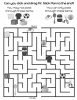
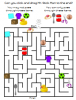
Students will complete the Electricity Maze Warm Up. Help students observe and generalize the materials that are conductors of electricity.
Presentation / Teacher Model ( 12 minutes )
Display Slide 1 in Powerpoint on the board or have students open it on their devices
Congratulations! You have just discovered a new planet! There's just one problem. The planet does not have any electricity! Imagine what it would be like to live on a planet without electricity. How would this affect you? Compare and contrast life with and without electricity below.
Main Activities ( 20 minutes )
Using the slides on the Powerpoint, discuss How Conductors and Insulators Affect the Flow of Electricity. Use the slides as examples.
Be sure to relate the flow of electricity to the warm-up maze activity by comparing the maze to a circuit.
Guided Practice is provided with the Circuit Challenge. The key is to close all of the circuits so the new planet will get electricity
Extension Task (5-15 minutes)
Scavenger Hunt: Students search their house or school to find examples of good conductors, good insulators, or both



 Electricity Maze Picture.PNG34.1 KB · Views: 443
 Circuits.PNG256.7 KB · Views: 173
 Printable Warmup.PNG103.9 KB · Views: 187
 Electricity Assessment.PNG45.3 KB · Views: 185